Start here
How to pray the Rosary, step by step
The short answer
Pray the Sign of the Cross, the Apostles’ Creed, one Our Father, three Hail Marys and a Glory Be. Then pray five decades, each one announcing a mystery, an Our Father, ten Hail Marys and a Glory Be. Finish with the Hail Holy Queen and the closing prayer. A standard rosary has fifty-nine beads: fifty-three for Hail Marys and six for Our Fathers.
The full sequence
This is the order used by the USCCB in its guide to praying the Rosary, with the places beginners most often ask about filled in. The wording of each prayer is collected on the prayers in order page, so you do not have to hold the texts in memory while you learn the structure.
Make the Sign of the Cross
Begin the prayer the way Catholic prayer usually begins, tracing the cross and naming the Father, the Son and the Holy Spirit.
Say the Apostles’ Creed on the crucifix
The Creed opens the Rosary by summarizing the faith the rest of the prayer moves through. Its full text is on the prayers page.
Pray an Our Father on the first bead
This is the first of the two large beads on the short strand, the part of the rosary that hangs below the loop.
Pray three Hail Marys on the next three beads
Three small beads follow the first large one. Traditionally these are offered for faith, hope and charity.
Pray a Glory Be
The Glory Be closes the opening prayers. No bead is assigned to it, so it is prayed between beads.
Announce the first mystery, then pray an Our Father
Each of the five decades begins this way. Many people add a short scripture reading after announcing the mystery.
Pray ten Hail Marys while meditating on the mystery
One Hail Mary for each of the ten small beads. The repetition is the space in which the scene is considered, not a race to the end of the decade.
Pray a Glory Be, and the Fatima Prayer if you use it
The Glory Be ends the decade. The Fatima Prayer is a customary addition, described by the USCCB as a prayer some say after each decade.
Repeat for the remaining four decades
Each decade follows the same pattern with the next mystery of the set you are praying that day.
Close with the Hail Holy Queen and the concluding prayer
After the fifth decade the Rosary turns to the Hail Holy Queen, a short dialogue, and a final collect, then the Sign of the Cross.
What is a decade in the Catholic Rosary?
A decade is one unit of the Rosary: a single mystery is announced, an Our Father is prayed, ten Hail Marys follow while the mystery is held in mind, and the unit ends with a Glory Be. Five decades make up the main loop of the prayer, which is why the Rosary is sometimes described as a prayer of five mysteries at a time.
The vocal prayers and the meditation are not two separate activities competing for attention. The USCCB describes the relationship this way:
“The repetition in the Rosary is meant to lead one into restful and contemplative prayer related to each Mystery. The gentle repetition of the words helps us to enter into the silence of our hearts, where Christ’s spirit dwells.”
That is also why the mysteries matter more than the bead count. A decade is not ten Hail Marys to be got through; it is ten Hail Marys with somewhere for the mind to rest. The mysteries page lists all twenty scenes with their references and spiritual fruits.
Where beginners usually get stuck
Almost every difficulty a beginner meets is a question about structure rather than about faith. These are the five that come up most often.
The two large beads on the short strand
The strand below the loop is not a decoration. It carries the opening prayers: the Creed on the crucifix, an Our Father on the first large bead, three Hail Marys on the small beads, then a Glory Be. The book gives this stretch particular attention because it is where many beginners lose the thread.
The transition into the loop
Once the opening prayers are finished, the prayer moves into the loop for the five decades. If you are unsure where the first decade begins, look for the large bead that starts the loop, announce the first mystery, and pray the Our Father there.
Which direction around the loop
Either direction is acceptable. The book answers this plainly rather than treating it as a test, which is a relief if you have ever watched two people pray in opposite directions and wondered who was wrong.
Which mysteries belong to today
The customary pattern assigns Joyful to Mondays and Saturdays, Luminous to Thursdays, Sorrowful to Tuesdays and Fridays, and Glorious to Wednesdays, with Sunday following the season. The full list is on the mysteries page.
Losing your place halfway through
Count the beads you have already prayed, or simply begin the decade again. Nothing in the prayer requires you to reconstruct the exact bead where your attention left.
What the book adds to this outline
An outline tells you the order. Teresa Lavin’s guide is written for the parts an outline cannot cover: what to do when the words will not stay in your head, what the phrases about sin and death actually mean, and why the prayer is addressed the way it is.
According to its own description, the book follows the prayer sequence from the Sign of the Cross and the Apostles’ Creed through the decades to the Hail Holy Queen and the closing prayers. It explains the fifty-nine beads and the repeated pattern of a decade, gives attention to the two large beads and the transition into the loop, and notes that either direction around the loop is acceptable.
It also sets out the four sets of mysteries with biblical references, scenes, meditations, spiritual fruits and brief phrases to retain during prayer, and it addresses the unfamiliar language of the prayers, including differences between translations.
A note on scope
The outline above is general background from the USCCB. What the book contains comes from its own listing. This site does not reproduce the book’s pages, and the book itself is the place to read its explanations in full.
Sources
The sequence, the definition of a decade and the description of repetition come from the USCCB’s guide to praying the Rosary. The quotation above is from the same page. Statements about the book come from its Amazon listing.
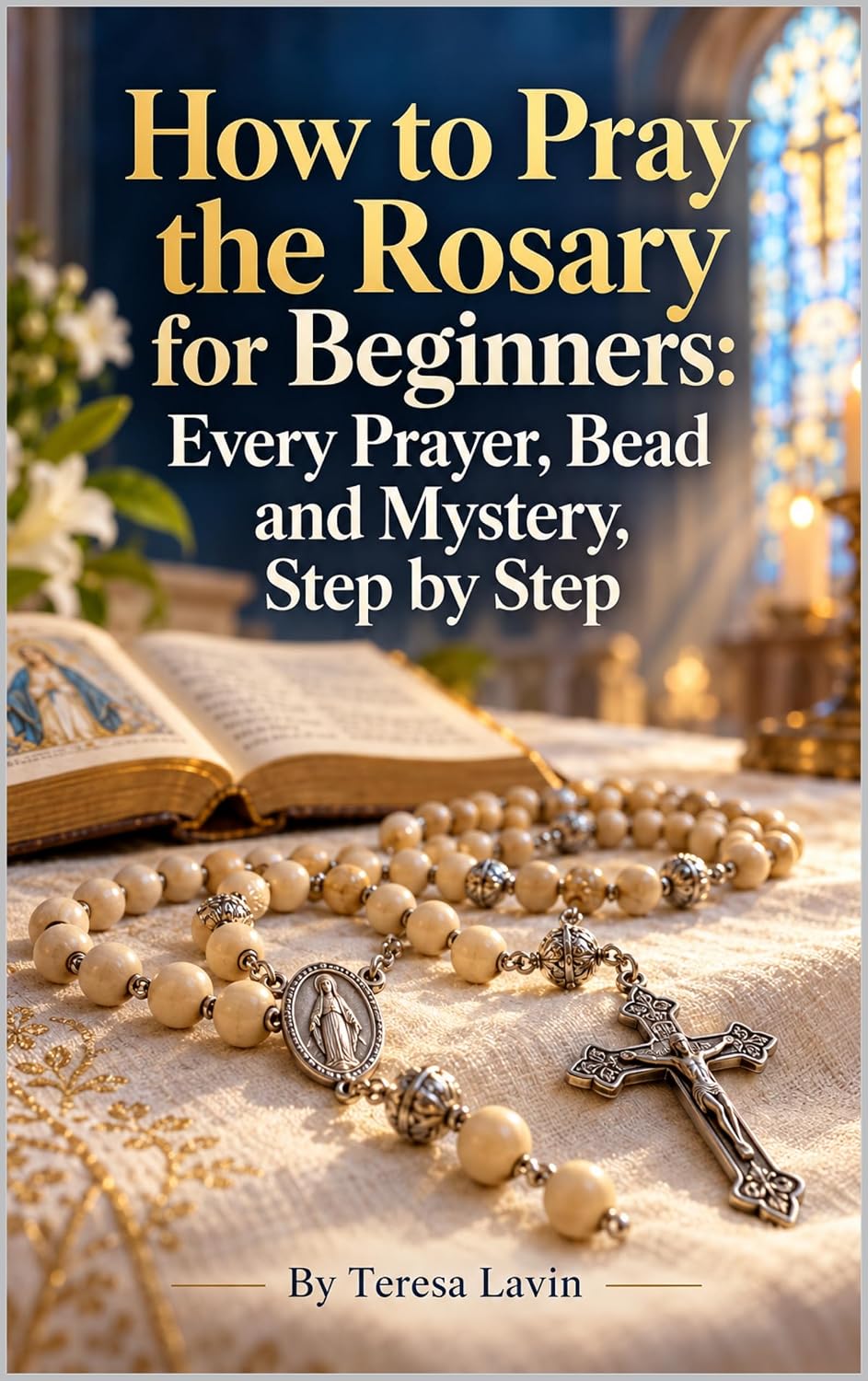
Where to find it
Learn the sequence once, then stop thinking about it.
Teresa Lavin’s guide walks through every prayer, bead and mystery, with the texts in front of you and room for the questions beginners actually ask.
How to Pray the Rosary for Beginners by Teresa Lavin · ASIN B0HQ2B4XTP