Questions
Marian intercession and worship: what is the difference?
The short answer
Intercession is asking someone to pray for you. Catholics ask Mary to intercede, the way one friend asks another for prayer. Worship is the honor owed to God alone. Honoring Mary is therefore not worship, and asking for her prayers is not a claim that she answers prayers on her own.
The difference in plain terms
The Rosary is, in the words of Pope John Paul II, a form of veneration of the Mother of God, and that devotion is directed to the center of the Christian faith rather than away from it. He quoted the Second Vatican Council’s formulation that when the Mother is honored, the Son “is duly known, loved and glorified.”
Veneration is not worship. The distinction matters because the Rosary is almost entirely made of prayers addressed to God: the Creed, the Our Father, the Glory Be and the doxology at the end. The Hail Mary itself asks Mary to pray for the one praying, in the same movement as asking a friend to remember you in their prayers.
Asking for prayer, not commanding an outcome
Intercession is request, not control. In Rosarium Virginis Mariae, John Paul II points to the wedding at Cana, where Mary makes the need known to Jesus: “They have no wine.” She brings the need; she does not overrule the answer.
Teresa Lavin’s guide explains intercession as asking for prayer, not as a guarantee that events will follow your wishes. That is an important distinction for anyone who has been told that a particular number of Rosaries will produce a particular result.
It is also the honest reading of the prayer. The Hail Mary asks Mary to pray for us “now and at the hour of our death.” It asks for prayer, not for a specific outcome.
Why the Rosary stays Christ-centred
Every one of the twenty mysteries is an event in the life of Christ, from the Annunciation to the Coronation, and the prayer is a way of accompanying him through them. The mysteries page lists all twenty with their references.
John Paul II described Mary’s role as entirely grounded in Christ’s and radically subordinate to it, so that it “in no way obscures or diminishes the unique mediation of Christ, but rather shows its power.” That is the theological shape of the distinction: not two competing mediators, but one mediation and a request for prayer within it.
What the book addresses
According to its description, the guide distinguishes the honor given to Mary from worship and explains intercession as asking for prayer. It also takes up the questions that usually sit behind that one:
- Indulgences, which the book addresses alongside intercession and veneration.
- The Rosary’s development over time, so the prayer is understood as something with a history rather than a single moment of origin.
- The language of the prayers, including phrases concerning sin, death and hell, and the differences between translations.
Those are the questions people are often reluctant to ask out loud, and treating them as reasonable is part of the book’s stated approach: making room for questions while explaining the prayer’s structure and meaning.
Questions worth asking
Teresa Lavin’s guide distinguishes honor from worship, explains intercession as asking for prayer, and takes up indulgences, the Rosary’s history and the wording of the prayers.
Sources
The quotations and the description of Mary’s role come from Pope John Paul II’s apostolic letter Rosarium Virginis Mariae (2002). The account of what the book addresses comes from its Amazon listing.
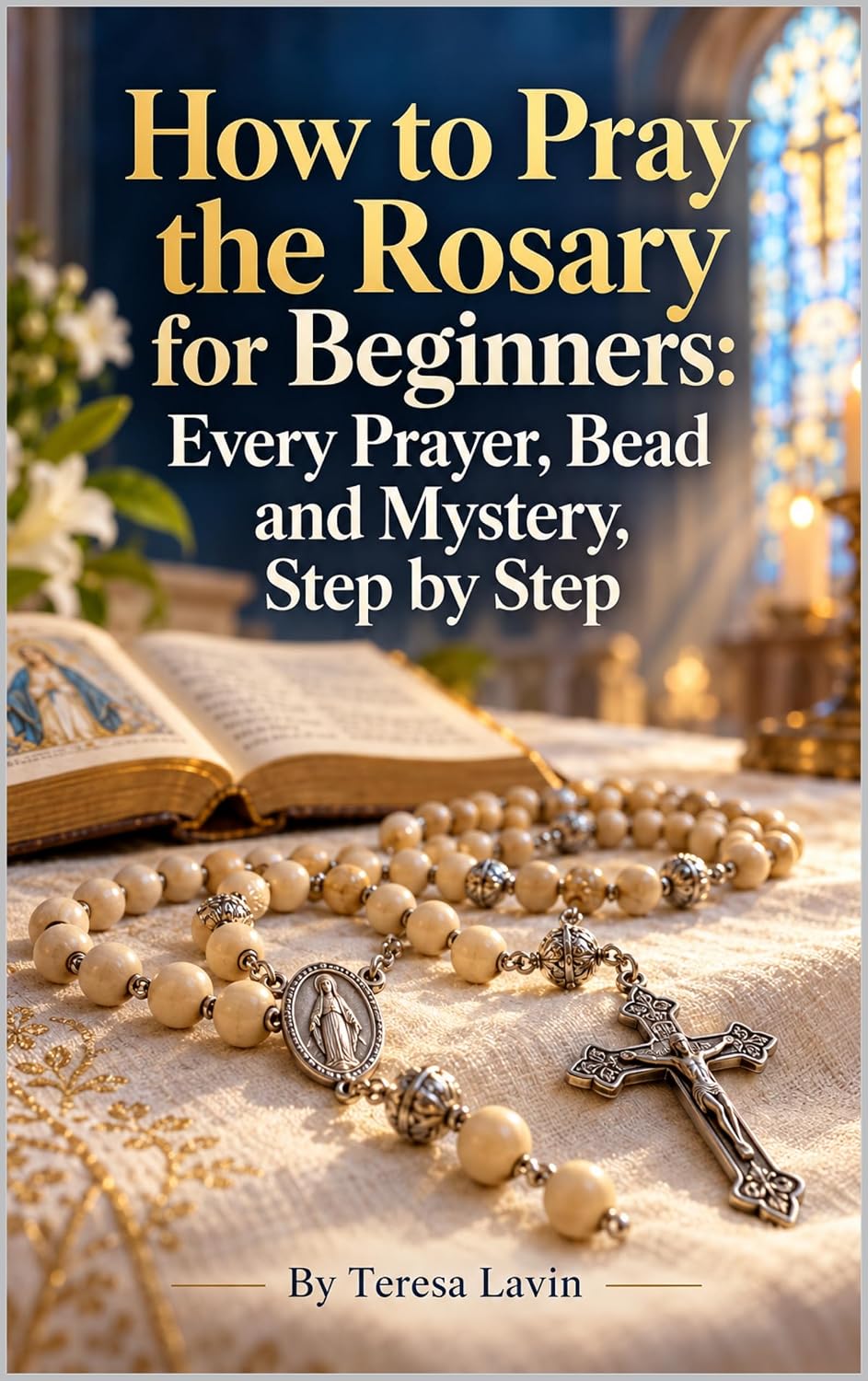
Where to find it
Bring the question with you.
The guide treats the difficult questions about Mary, worship and the wording of the prayers as part of learning to pray, not as interruptions to it.
How to Pray the Rosary for Beginners by Teresa Lavin · ASIN B0HQ2B4XTP