Beads
How Rosary beads map to each prayer
The short answer
The short strand carries the opening prayers: the Creed on the crucifix, an Our Father on the first large bead, and three Hail Marys on the next three beads. The loop carries five decades, each with one large bead for an Our Father and ten small beads for Hail Marys. That is fifty-nine beads in total.
Why a rosary has fifty-nine beads
The count follows the prayer. A standard rosary has fifty-three small beads for Hail Marys and six large beads for Our Fathers. Fifty of the small beads sit in the loop, ten per decade, with the other three on the short strand. Five of the large beads open the five decades, and the sixth is the first bead below the loop. Fifty-three plus six is fifty-nine.
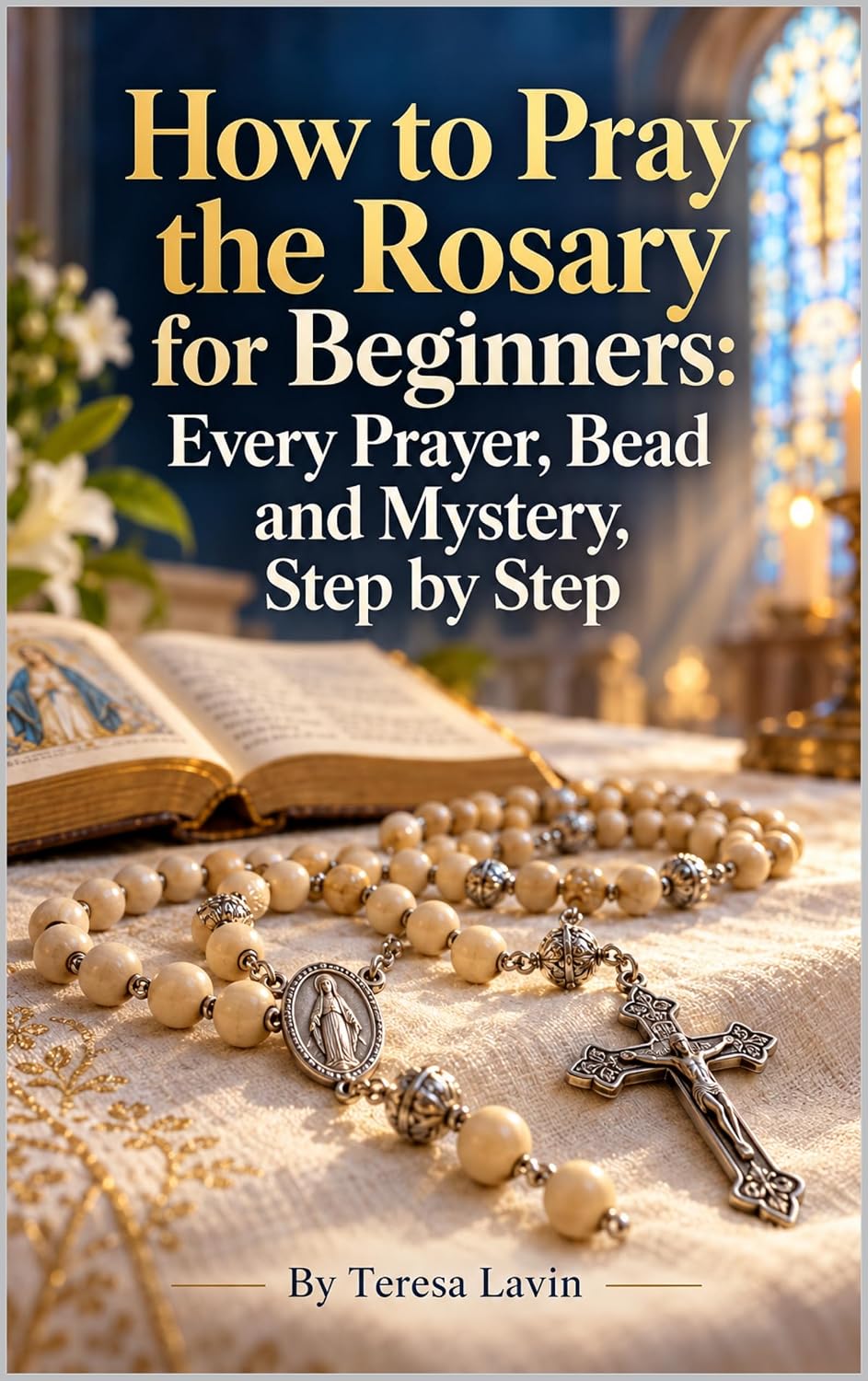
Teresa Lavin’s guide explains the Rosary’s fifty-nine beads and the repeated pattern of a decade, and it gives particular attention to the two large beads on the short strand and to the transition into the loop, which is exactly where a first-time reader tends to stall.
The bead-by-bead map
Short strand
Cross: Creed. Large bead: Our Father. Three small beads: three Hail Marys. Then a Glory Be.
The loop
- Decade 1
- Decade 2
- Decade 3
- Decade 4
- Decade 5
Each decade: one large bead for the Our Father, ten small beads for the Hail Marys, then a Glory Be. Five decades hold five Our Fathers and fifty Hail Marys.
| Where | Prayer | Note |
|---|---|---|
| The crucifix | Sign of the Cross, then the Apostles’ Creed | The Creed is prayed while holding the cross. |
| First large bead | Our Father | On the short strand, below the loop. |
| Next three small beads | One Hail Mary on each bead | The opening three Hail Marys. |
| Between the beads | Glory Be | No bead is assigned; it closes the opening prayers. |
| Large bead that opens each decade | Our Father | The mystery is announced first, then the Our Father. |
| Ten small beads in each decade | One Hail Mary on each bead | Prayed while meditating on the mystery of that decade. |
| End of each decade | Glory Be, then the Fatima Prayer if you use it | The Fatima Prayer is customary, not required. |
| After the fifth decade | Hail Holy Queen, versicle, concluding prayer | The Rosary closes with the Sign of the Cross. |
The short strand, in detail
The short strand hangs below the loop and holds four beads: one large and three small. The large bead receives the opening Our Father, and the three small beads receive the three opening Hail Marys. The Creed is prayed on the crucifix before any bead is touched, and a Glory Be follows the three Hail Marys.
The two large beads the book singles out are easy to confuse because they sit close together in the hand: the one on the short strand and the one that opens the first decade. Both receive an Our Father, but the second one belongs to the first mystery, not to the opening prayers.
The loop and its five decades
Once the opening prayers are complete, the prayer moves into the loop. Each decade is a group of eleven beads: a large bead for the Our Father, then ten small beads for the Hail Marys. Five of these groups make up the loop, and each group is preceded by the announcement of a mystery.
The Glory Be that ends a decade is not tied to a bead. Neither is the Fatima Prayer, which is a customary addition rather than part of the basic sequence. If you are counting beads to find your place again, count the small beads of the decade you are in; the prayers between decades have no bead of their own.
The twenty scenes that give each decade its subject are listed on the mysteries page, and the words for every prayer are on the prayers page.
Which direction around the loop?
Either direction is acceptable. The Rosary is a sequence of prayers, not a route with a required orientation, and the book answers the question in that reassuring way rather than making it a rule to get right.
In practice most people follow the strand from the cross into the loop and keep moving in the same direction until they return to where they started. Consistency helps you keep your place, which is the only real purpose the direction serves.
The bead problem, solved on paper
Teresa Lavin’s guide explains the fifty-nine beads, the repeated decade, the two large beads on the short strand and the move into the loop, so you can learn the map once and then stop thinking about it.
Sources
The order of prayers on the beads follows the USCCB’s guide to praying the Rosary. The fifty-nine bead count and the attention to the two large beads and the transition into the loop are described in the book’s own listing.
Where to find it
A bead map you can hold in your head.
The guide pairs the structure of the prayer with the object in your hand, including the two beads and the transition that confuse almost every beginner.
How to Pray the Rosary for Beginners by Teresa Lavin · ASIN B0HQ2B4XTP