Mysteries
The four sets of Rosary mysteries, explained
The short answer
The four sets are the Joyful, Luminous, Sorrowful and Glorious Mysteries. Each contains five scenes, so twenty in all. The Luminous set was added by Pope John Paul II in 2002. A different set is customary on different days, but the choice of set is not what makes a Rosary valid.
The four sets at a glance
The names, references and fruits below follow the USCCB’s guide to praying the Rosary. The customary days are the ones it lists: Joyful on Mondays, Saturdays and Sundays in Advent; Luminous on Thursdays; Sorrowful on Tuesdays, Fridays and Sundays in Lent; Glorious on Wednesdays and Sundays outside Advent and Lent.
The Joyful Mysteries
Traditionally prayed on mondays, saturdays, and sundays in advent
The Joyful Mysteries follow the early life of Christ, from the announcement of his birth to the finding of the boy Jesus in the Temple.
| Mystery | Reference | Fruit |
|---|---|---|
| The Annunciation | Luke 1:26-27 | Humility |
| The Visitation | Luke 1:39-42 | Love of Neighbor |
| The Nativity | Luke 2:1-7 | Poverty |
| The Presentation in the Temple | Luke 2:21-24 | Purity of Heart and Body |
| The Finding in the Temple | Luke 2:41-47 | Devotion to Jesus |
The Luminous Mysteries
Traditionally prayed on thursdays
The Luminous Mysteries were added by Pope John Paul II in 2002 and turn to Christ’s public ministry, from his baptism to the gift of the Eucharist.
| Mystery | Reference | Fruit |
|---|---|---|
| The Baptism of Christ in the Jordan | Matthew 3:16-17 | Openness to the Holy Spirit |
| The Wedding Feast at Cana | John 2:1-5 | To Jesus through Mary |
| The Proclamation of the Coming of the Kingdom of God | Mark 1:15 | Conversion |
| The Transfiguration | Matthew 17:1-2 | Desire for holiness |
| The Institution of the Eucharist | Matthew 26:26 | Adoration |
The Sorrowful Mysteries
Traditionally prayed on tuesdays, fridays, and sundays in lent
The Sorrowful Mysteries stay with the Passion, from the Agony in the Garden to the Crucifixion and Death.
| Mystery | Reference | Fruit |
|---|---|---|
| The Agony in the Garden | Matthew 26:36-39 | Obedience to God’s Will |
| The Scourging at the Pillar | Matthew 27:26 | Mortification |
| The Crowning with Thorns | Matthew 27:27-29 | Courage |
| The Carrying of the Cross | Mark 15:21-22 | Patience |
| The Crucifixion and Death | Luke 23:33-46 | Sorrow for our Sins |
The Glorious Mysteries
Traditionally prayed on wednesdays, and sundays outside advent and lent
The Glorious Mysteries move from the empty tomb to the promise that follows, ending with the Coronation of Mary.
| Mystery | Reference | Fruit |
|---|---|---|
| The Resurrection | Luke 24:1-5 | Faith |
| The Ascension | Mark 16:19 | Hope |
| The Descent of the Holy Spirit | Acts 2:1-4 | Wisdom |
| The Assumption | Luke 1:48-49 | Devotion to Mary |
| The Coronation of Mary | Revelation 12:1 | Grace of a happy death |
What a mystery is for
A mystery is not a riddle. In the Rosary the word names an event from the Gospel that the mind rests on while the Hail Marys are prayed. The USCCB describes the repetition of the prayer as a way of entering “restful and contemplative prayer related to each Mystery.” The words carry the time; the mystery gives the time somewhere to go.
Pope John Paul II made the same point about announcing the mystery in his 2002 letter on the Rosary. Announcing it, he wrote, is “to open up a scenario” on which to focus attention, which is why many people add a short scripture passage after the announcement.
This is also why the four sets are not interchangeable decoration. Each one holds a different stretch of the same life, and praying a set is a way of spending time there rather than covering ground.
How the book handles the mysteries
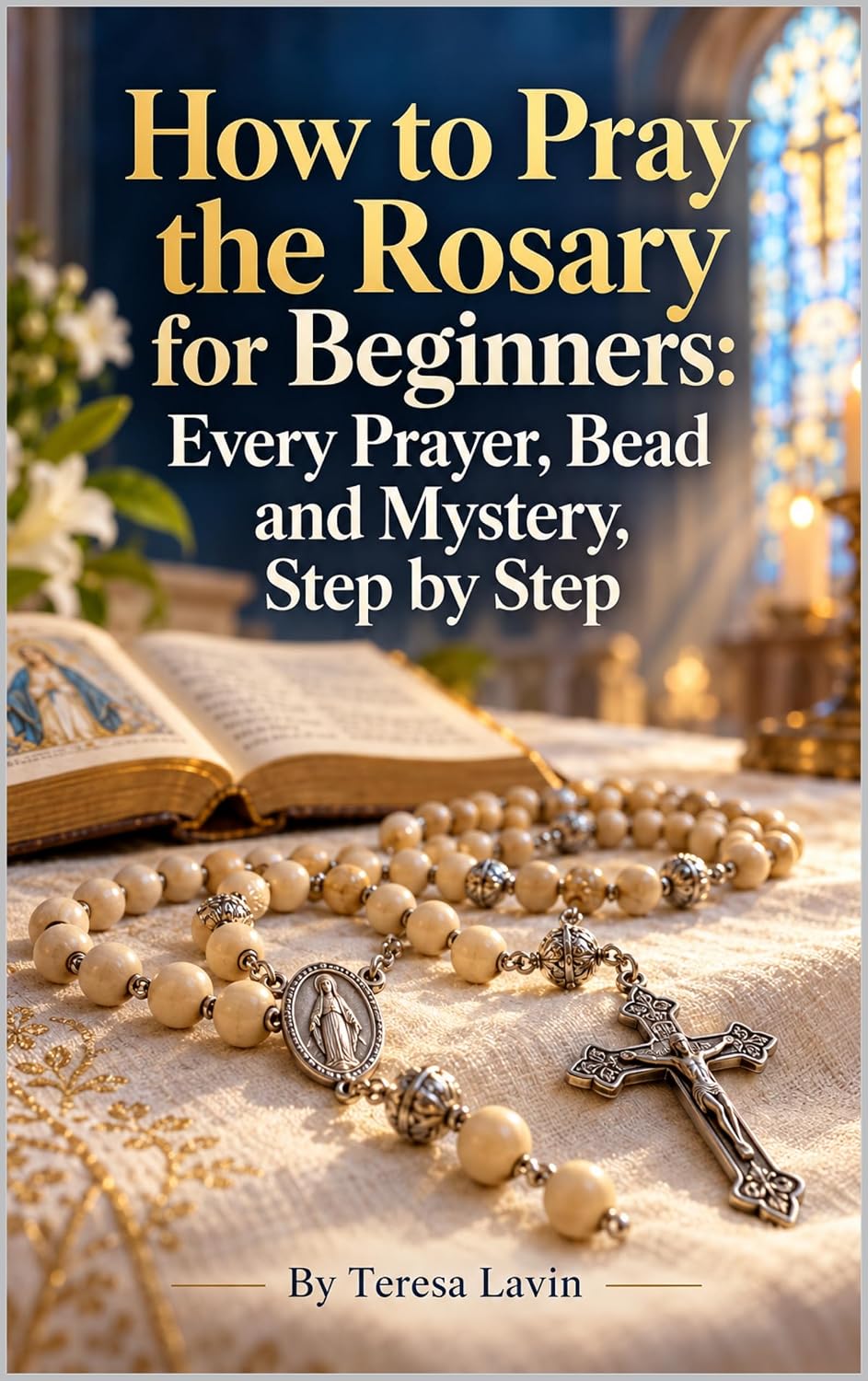
Teresa Lavin’s guide presents each set with biblical references, the scene itself, a meditation, its spiritual fruit and a brief phrase to retain during prayer. That last element is the practical one: a short phrase gives a wandering mind something to return to without stopping the prayer.
The meditations are connected to everyday choices. According to the book’s description, the Visitation is linked with love of neighbor expressed in encouragement, a meal or a visit; the Nativity with gratitude and freedom from demands for possessions, status, control or comfort; the Proclamation of the Kingdom with repentance as an invitation to concrete change rather than self-hatred.
The treatment of sorrow is attentive in the same way. Reflection on the Crucifixion allows room for grief, silence, anger or numbness, and faithfulness is not equated with self-punishment or isolation. Seeking medical, emotional, spiritual or practical help is presented as compatible with faith.
These are the book’s own reflections, not a summary of Church teaching, and the guide is the place to read them in full. For the scenes, references and fruits above, the USCCB’s page is the source.
Twenty scenes, one at a time
The guide gives every mystery a scene, a reference, a meditation, a fruit and a phrase to carry, so a decade has somewhere to rest besides the count.
Sources
The names, scripture references, fruits and customary days come from the USCCB’s guide to praying the Rosary. The two quotations above are from that page and from Pope John Paul II’s apostolic letter Rosarium Virginis Mariae. Descriptions of the book’s meditations come from its Amazon listing.
Where to find it
The mysteries are the point, not the bead count.
Teresa Lavin’s guide gives each of the twenty scenes a reference, a meditation, a spiritual fruit and a short phrase for the decade ahead.
How to Pray the Rosary for Beginners by Teresa Lavin · ASIN B0HQ2B4XTP